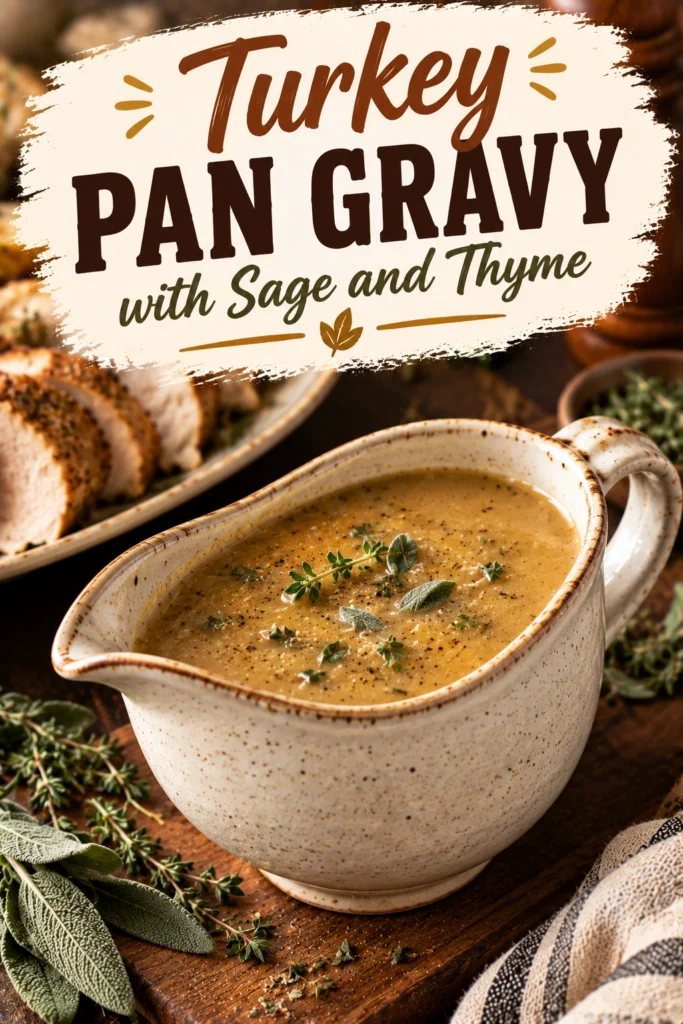
A velvety, savory sauce with a deep golden hue defines a successful roast dinner. This gravy captures the essence of roasted poultry, blending earthy herbs with rich pan drippings to create a coating that clings perfectly to mashed potatoes or sliced turkey.
The recipe focuses on transforming the browned bits left in the roasting pan into a smooth, cohesive sauce. It balances the saltiness of the drippings with the aromatic brightness of garden herbs.
Home cooks appreciate this method because it utilizes existing flavors rather than starting from scratch with a bouillon cube. The result is a more complex, layered taste that feels authentic and homemade.
Unlike store-bought versions that often taste overly salty or metallic, this pan gravy has a natural depth and a buttery finish. It avoids the artificial thickeners found in packets, relying instead on a traditional roux.
Anyone looking to elevate their holiday spread or a simple Sunday roast will find this approach reliable. It works equally well for a massive feast or a small family dinner.
Because it uses the roasting pan directly, this process minimizes cleanup for the busy cook. All the flavor stays in one place until it hits the plate.
Follow these steps to achieve a lump-free consistency and a professional flavor profile.
- ●Why You’ll Love This Recipe
- ●A Brief Background on the Flavor Profile
- ●Perfect for Holiday Feasts and Family Dinners
- ●The Importance of Pan Drippings
- ●The Role of Woody Herbs
- ●Key Ingredients
- ●How to Make It
- ●Pro Tips
- ●Delicious Variations
- ●Best Ways to Serve
- ●Storage and Leftovers
- ●Frequently Asked Questions
- ●Why This Recipe Belongs in Your Weekly Rotation
- ●Final Thoughts
Creating a high-quality gravy doesn’t require professional training, only a few pantry staples and the remnants of your roast. This method produces a consistent result every time.
- ●Utilizes the flavorful fond left in the roasting pan.
- ●Combines sage and thyme for a classic autumn aroma.
- ●Requires very few additional ingredients.
- ●Takes less than 15 minutes to assemble once the turkey rests.
- ●Achieves a professional, silky texture without lumps.
- ●Pairs beautifully with a variety of starches.
- ●Customizable salt and pepper levels based on your drippings.
- ●Reduces the need for extra pots and pans.
- ●Offers a fresh alternative to processed gravy mixes.
- ●Provides a comforting, warm finish to any poultry dish.
These benefits make it a dependable addition to any kitchen, ensuring your meat never tastes dry.
A Brief Background on the Flavor Profile |
The success of this gravy relies on the Maillard reaction, the browning process that occurs when the turkey roasts. These caramelized proteins, known as fond, provide a base of savory depth that cannot be replicated .
Sage and thyme are chosen specifically because they complement the natural sweetness of turkey. Sage provides a slightly peppery, pine-like note, while thyme adds a subtle lemony brightness that cuts through the richness of the butter and fat.
This approach mimics the classic techniques found in Smothered Pork Chops Comfort Food With Golden Gravy, where the pan essence creates the primary flavor.
Perfect for Holiday Feasts and Family Dinners |
During large holidays, the oven is often crowded and timing is tight. This recipe is ideal because it happens while the turkey is resting on a carving board, making use of those critical twenty minutes of downtime.
For family dinners, a rich gravy turns a simple roasted bird into a celebratory meal. It provides the necessary moisture to keep the meat succulent, even if the turkey was slightly overcooked.
It also works well for meal prep. Making a larger batch allows you to repurpose leftovers into something like an Easy Biscuits And Gravy Casserole Comfort Food Delight the following morning.
The Importance of Pan Drippings |
Pan drippings are the concentrated essence of the roasted meat and vegetables. They contain dissolved minerals, fats, and browned proteins that act as a natural flavor enhancer for the rest of the sauce.
Using these drippings removes the need for excessive salt, as the concentrated juices already carry a savory punch. The fat provides the necessary medium to cook the flour, removing the raw taste of the wheat.
The Role of Woody Herbs |
Sage and thyme belong to the woody herb family, meaning their flavors are more robust and heat-stable than soft herbs like parsley. This allows them to infuse the gravy without disappearing during the simmering process.
Adding these herbs toward the end of the process preserves their aromatic oils. This ensures that the first thing you smell when the gravy is poured is a fresh, earthy scent that signals a home-cooked meal.
Key Ingredients |
Each component plays a specific role in balancing the final taste and consistency of the sauce.
- ●Turkey drippings — These provide the foundational savory flavor and the fat needed for the roux.
- ●Butter — This adds a creamy richness and ensures there is enough fat if the pan was lean.
- ●All-purpose flour — This acts as the thickening agent to create a smooth, velvety texture.
- ●Turkey or chicken stock — This provides the bulk of the liquid and reinforces the poultry flavor.
- ●Fresh sage — This adds an earthy, autumnal note that is traditional for turkey dishes.
- ●Fresh thyme — This contributes a light, floral aroma to balance the heavy fats.
- ●Black pepper — This provides a sharp contrast to the richness of the butter and stock.
How to Make It |
Achieving a lump-free gravy requires a steady hand and attention to the temperature of the pan.
- Separate the drippings: Pour the liquids from the roasting pan through a fine-mesh strainer into a glass measuring cup. Separate the clear fat from the concentrated juices, keeping about 1/4 cup of fat for the roux; discarding too much fat will result in a thin, flavorless sauce.
- Sauté the roux: Place the roasting pan over medium heat or transfer the fat to a saucepan. Whisk in the flour and cook for 2-3 minutes until the mixture smells nutty and looks like a pale paste; avoiding undercooking the flour prevents the gravy from tasting like raw dough.
- Deglaze the pan: Slowly pour in a small amount of stock while scraping the bottom of the pan with a wooden spoon. Ensure all the browned bits (fond) are dissolved into the liquid, as these contain the most concentrated flavor.
- Incorporate the stock: Gradually whisk in the remaining stock and the reserved pan juices. Maintain a steady simmer and whisk constantly to ensure the flour integrates fully without forming clumps.
- Infuse the herbs: Stir in the minced sage and thyme. Let the gravy simmer for another 5 minutes on low heat; this allows the woody herbs to release their oils without burning.
- Final Seasoning: Taste the gravy and add salt and black pepper as needed. Be cautious with salt, as the pan drippings and stock are often already salty; adding salt too early can lead to an over-seasoned sauce.
- Strain for smoothness: Pour the finished gravy through a strainer into a serving boat. This removes any remaining herb stems or unmixed flour bits, resulting in a professional, glossy appearance.
1Small adjustments in technique can lead to a significantly better result.
- ●2Use a whisk: A whisk is far more effective than a spoon for breaking up flour clumps and incorporating fat.
- ●3Temper the stock: Using warm stock instead of cold stock prevents the roux from seizing and helps the gravy thicken more evenly.
- ●4Control the heat: Keep the heat at a medium-low simmer; boiling the gravy too vigorously can break the emulsion and cause the fat to separate.
- ●5Strain twice: For a truly restaurant-quality finish, strain the drippings first and the final gravy second.
- ●6Balance with acidity: If the gravy feels too heavy, a tiny splash of lemon juice or white wine can brighten the flavor.
Delicious Variations |
While the classic version is timeless, you can adapt the flavor profile to suit different preferences.
- ●Creamy Sage Gravy: Stir in two tablespoons of heavy cream at the very end for a richer, paler sauce.
- ●Mushroom Turkey Gravy: Sauté finely diced mushrooms in the butter before adding the flour to add an earthy, umami depth.
- ●Garlic Infusion: Add one clove of minced garlic to the roux for a more pungent, savory kick.
- ●White Wine Twist: Replace 1/2 cup of stock with a dry white wine to add a sophisticated acidity.
- ●Cornstarch Alternative: For a gluten-free version, whisk cornstarch into cold stock before adding it to the pan.
These changes allow the gravy to adapt to different seasonal ingredients or dietary needs.
Best Ways to Serve |
The versatility of a well-made gravy means it can enhance more than just the main bird.
- ●Drizzled over sliced turkey breast and drumsticks.
- ●Poured generously over a mountain of garlic mashed potatoes.
- ●Served alongside roasted root vegetables like carrots and parsnips.
- ●Used as a topping for a Ultimate Fluffy Biscuits And Gravy Hashbrown Bake Recipe
- ●Mixed into leftover turkey sandwiches for extra moisture.
For a formal presentation, serve the gravy in a warmed porcelain boat to keep the sauce from thickening too quickly on the table.
If serving casually, a simple bowl allows guests to ladle their own portions, ensuring everyone gets the exact amount of herb-infused goodness they prefer.
Storage and Leftovers |
Refrigerating
Store leftover gravy in an airtight glass container in the refrigerator for up to 4 days. The sauce will naturally thicken and may form a gelatin-like consistency as it cools, which is a sign of a good, collagen-rich stock.
Reheating
Warm the gravy in a small saucepan over medium-low heat. Add a splash of water or stock to loosen the consistency and whisk continuously until it returns to a smooth, pourable state.
Freezing
Freeze gravy in freezer-safe containers or silicone molds for up to 3 months. Thaw overnight in the refrigerator before reheating on the stove to maintain the emulsion.
Frequently Asked Questions |
- ●Q: What do I do if my gravy is too thin?A: If the sauce is too runny, mix one teaspoon of cornstarch with a tablespoon of cold water to create a slurry. Stir this mixture into the simmering gravy and cook for another two minutes until the desired thickness is achieved.
- ●Q: How can I fix lumpy gravy?A: The fastest way to remove lumps is to pour the gravy through a fine-mesh strainer. If the lumps are small, you can also use an immersion blender for thirty seconds to emulsify the sauce back into a smooth state.
- ●Q: Can I make this without a roasting pan?A: Yes, you can use 1/4 cup of butter and 1/4 cup of store-bought turkey or chicken stock concentrate. Follow the same roux process, though you will miss out on the deep, caramelized flavors found in the fond.
- ●Q: Why did my gravy separate into oil and liquid?A: Separation usually happens when the gravy is boiled too hard or if the roux wasn’t cooked long enough to bind the fat. Lower the heat and whisk vigorously to try and bring the emulsion back together.
- ●Q: Can I use dried herbs instead of fresh?A: Dried herbs are more concentrated, so use about one-third of the amount called for in the recipe. Add them earlier in the process, specifically when adding the stock, to allow them time to rehydrate.
Why This Recipe Belongs in Your Weekly Rotation |
While traditionally reserved for holidays, the technique of making a pan gravy is a fundamental skill that improves every meat dish. Whether you are roasting a chicken or preparing a Quick Ground Turkey And Zucchini Skillet Recipe, knowing how to build a sauce from pan remnants reduces waste and maximizes flavor.
Incorporating this into your routine encourages the use of fresh herbs and reduces reliance on processed, sodium-heavy canned sauces. It transforms simple ingredients into a cohesive meal that feels luxurious without requiring expensive components.
Mastering this recipe ensures that no matter the occasion, you can provide a comforting, moist, and aromatic finish to your proteins. It is the ultimate way to wrap up a hearty meal.
Final Thoughts |
This Turkey Pan Gravy with Sage and Thyme combines the rich, caramelized flavors of roasting with the bright, earthy notes of classic herbs. roasting pan, you capture every ounce of flavor available, resulting in a professional, silky sauce.
Making this gravy from scratch allows you to control the seasoning and quality, providing a far superior experience than any instant mix. It is a manageable process that adds immense value to your dining table.
Bring a touch of warmth and tradition to your next meal golden gravy over your favorite roast.
Turkey Pan Gravy with Sage and Thyme
- Total Time: 17 minutes
- Yield: 3 cups 1x
Description
A rich, velvety turkey gravy made from pan drippings, infused with fresh sage and thyme for a classic holiday flavor. Perfectly smooth and savory.
Ingredients
- 1/4 cup turkey pan drippings (fat)
- 1/4 cup unsalted butter
- 1/4 cup all-purpose flour
- 2 cups turkey or chicken stock
- 1/2 cup reserved pan juices (concentrated)
- 1 tablespoon fresh sage, finely minced
- 1 tablespoon fresh thyme, finely minced
- 1/2 teaspoon black pepper
- Salt to taste
Instructions
- Strain the turkey pan drippings through a fine-mesh sieve to separate the fat from the juices. Measure out 1/4 cup of the fat.
- Place the roasting pan over medium heat or transfer the 1/4 cup of fat and butter to a saucepan. Melt the butter completely.
- Whisk in the all-purpose flour and cook for 2-3 minutes, stirring constantly, until the roux is golden and smells slightly nutty.
- Slowly pour in 1/2 cup of the stock while scraping the bottom of the pan with a wooden spoon to release all the browned bits.
- Gradually whisk in the remaining stock and the reserved pan juices until the mixture is smooth.
- Stir in the minced sage, thyme, and black pepper. Lower the heat to a simmer and cook for 5 minutes.
- Taste the sauce and add salt if necessary. Pour through a strainer into a serving dish for a perfectly smooth finish.
- Prep Time: 5 minutes
- Cook Time: 12 minutes
- Category: Sauce
- Method: Stovetop
- Cuisine: American